The forest edge was quiet in the way only early morning can be—soft light filtering through tall trees, mist still hanging low above the ground, and the occasional sound of birds calling from deep within the woods.
It was a place where deer often moved cautiously between feeding grounds, always alert, always listening. Everything in this part of the forest followed rhythm and instinct.
A large male deer stepped out from the tree line, his antlers wide and fully developed.
He moved slowly, scanning the open space ahead. The ground was uneven here, marked by old human traces—broken posts, rusted objects, and sections of fencing that once separated farmland from wild land. Most of it had been abandoned for years, slowly being reclaimed by nature.
But not all of it had become harmless.
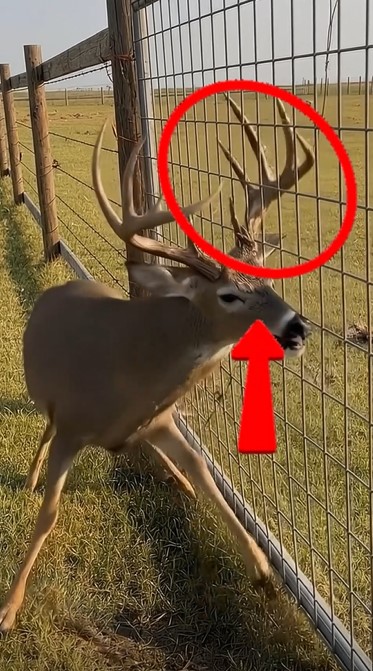
As the deer approached a narrow passage between two trees, he tried to step through what looked like an open gap. What he didn’t realize was that a section of metal fence had collapsed and twisted into a tight, jagged frame. Thin metal wires and bent bars formed a hidden trap at head height.
When he lowered his head slightly to pass through—
His antlers caught.
At first, it didn’t seem serious. He paused, shifted his weight, and tried to pull back gently. But the antlers, wide and branching, had hooked deeply into the twisted metal. The more he moved, the more the structure held him in place.
He tried again, stronger this time.
The fence creaked.
Metal scraped against bone.
The deer jerked backward, then forward, trying to find an angle to free himself, but every movement only made the entanglement worse. The fence was old but still strong enough to resist his strength. His antlers were now fully trapped, locked between multiple bends of rusted metal.
Panic began to rise.
He pulled harder.
The sudden force caused the fence to shake loudly, echoing through the quiet forest. Birds scattered from nearby branches. The deer stopped for a moment, breathing heavily, listening. Then he tried again, twisting his head sharply to one side.
Still stuck.
The antlers would not come free.
Minutes passed like that—struggling, stopping, trying again. Each attempt drained more energy, and each failure made the situation more dangerous. The deer began to realize something important: the more he fought directly, the more trapped he became.
He stood still for a moment, chest rising and falling rapidly. His ears flicked constantly, listening for any sign of danger. In the wild, being trapped is one of the most vulnerable positions an animal can be in.
Then, faintly, he heard something approaching.
Footsteps.
Not fast. Not threatening. Slow and careful.
On the forest path nearby, a hiker had noticed unusual movement and sound coming from the edge of the trees. At first, it was just the loud rustling of branches, followed by the distinct sound of metal scraping. Curious and concerned, he changed direction and moved toward it.
When he reached the clearing, he stopped immediately.
The sight was clear: a deer with large antlers trapped tightly in a broken metal fence, struggling but exhausted.
The hiker didn’t move closer right away.
He knew that sudden presence could scare the animal and make it thrash again, which might injure it further. Instead, he lowered his body slightly and kept a safe distance, speaking softly in a calm tone.
“Hey… easy. I see you. I’m not going to hurt you.”
The deer turned his head slightly toward the sound, nostrils flaring. He was tense, but he didn’t charge or flee. He was too stuck—and too tired—to react aggressively.
The hiker slowly assessed the situation.
The antlers were caught in multiple points of twisted metal, meaning pulling directly would likely cause injury. The structure itself needed to be carefully opened or loosened. He looked around quickly and spotted a fallen branch strong enough to act as a lever.
He moved slowly, deliberately, never making sudden gestures.
Each step was careful.
He placed the branch near a bent section of the fence and gently applied pressure. The metal groaned slightly but did not fully give. He adjusted his angle and tried again, working to widen the gap just enough to relieve pressure on one side of the antlers.
The deer shifted instinctively, reacting to the movement, but stayed relatively still.
Deer Antlers Snagged in Metal Fence pic.twitter.com/Wiyl22weJt
— Animal Rescue Stories (@AnimalStory5) May 13, 2026
A tense silence filled the forest, broken only by the faint creaking of metal and distant bird calls.
The hiker paused frequently, giving the animal time to calm before continuing. Then, slowly, he managed to bend one section of the fence outward just enough to reduce the grip on the antlers.