The road was quiet, winding through a stretch of countryside where the fields rolled out in soft greens and golds. A cyclist moved steadily along the narrow asphalt, the only sound being the rhythmic hum of tires and the faint rustle of wind brushing through tall grass at the roadside.
It was an ordinary ride.
Until it wasn’t.
About halfway down a slight incline, the cyclist slowed. Something ahead broke the pattern of the landscape—an irregular shape near the edge of the ditch, partially hidden by weeds and dry branches. At first, it looked like debris. But as he got closer, the shape moved.
A dog.
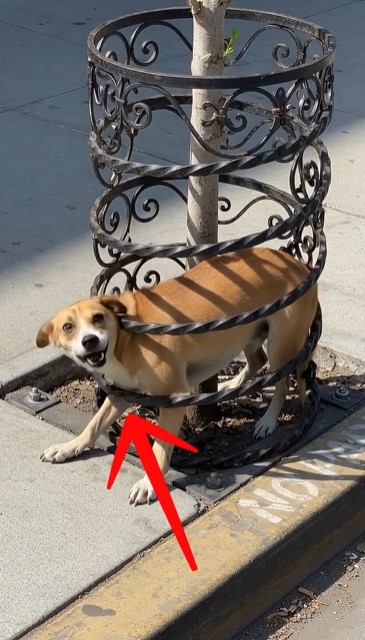
It was lying low to the ground, one of its legs caught in a metal trap.
The cyclist immediately stopped.
The air felt different the moment he stepped off the bike. He approached slowly, carefully, trying not to startle the animal. The dog lifted its head weakly, ears pinned back, eyes alert but filled with pain and exhaustion. It didn’t growl. It didn’t bark. It simply watched him as if trying to decide whether this was another threat or something different.
The metal trap was old and rusted, clamped tightly around the dog’s paw. Every small movement made it tense further. The mechanism had clearly been left behind or forgotten, hidden under grass until something stepped into it.
The dog had been there for some time.
Not hours in a comfortable sense—but long enough for fatigue to set in, for hope to thin, for every sound in the distance to feel like it might never turn into help.
The cyclist knelt a few feet away, keeping his voice calm.
“Hey… it’s okay. I’m not going to hurt you.”
The dog didn’t respond, but it didn’t try to pull away either. That alone was important.
He looked around quickly. No houses nearby. No other people. No immediate tools except what he carried in a small repair kit attached to his bike. It wasn’t designed for this kind of situation, but it was all he had.
He took a slow breath and assessed the trap.
It was a spring-loaded metal jaw mechanism, the kind that required careful release rather than force. Trying to pull the dog free would only increase the pressure. The priority had to be control—stabilize the mechanism first, then release it safely.
The cyclist removed his gloves and put them back on tighter. He spoke softly again, more to keep the dog calm than anything else.
“I’m going to help you. Just stay still.”
He shifted closer.
The dog tensed slightly but did not resist. Its breathing was uneven, but it remained in place. Whether from exhaustion or instinct, it seemed to understand that struggling wasn’t helping.
Carefully, he examined the trap’s hinge point. Rust had weakened parts of it, but the main tension spring was still active. One wrong movement could snap it tighter.
He looked around again and spotted a small flat stone near the roadside. Not perfect, but usable.
He placed it gently beside the mechanism, testing how it might help distribute pressure. Slowly, he began inserting a thin metal tool from his kit into the locking joint, trying to find the release point.
The dog flinched once when the metal shifted.
The cyclist stopped immediately.
“Easy… easy. I’ve got you.”
He waited until the dog relaxed slightly again. Then continued, even slower this time.
Minutes stretched.
The sun shifted a little lower in the sky, casting longer shadows across the road and grass. The world felt suspended in that narrow moment where everything depended on precision and patience.
Finally, there was a small click.
The mechanism shifted.
Not fully open—but enough to change the pressure on the dog’s leg.
The cyclist paused, holding it steady.
“Almost…”
He adjusted again, carefully guiding the tension away from the trapped paw. The metal resisted, but slowly gave way under controlled movement.
The dog let out a small sound—not loud, not panicked, but a release of pressure it had been holding for too long.
That moment mattered.
The cyclist kept steady.
A final adjustment.
Then—
The trap loosened completely.
He didn’t move immediately. He waited, making sure it wouldn’t snap back. Then, gently, he lifted the mechanism away from the dog’s leg.
For a second, nothing happened.
The dog stayed still, as if unsure whether it was real.
Then it slowly pulled its paw back.
Careful. Testing. Free.
It shifted its weight, standing unevenly at first. The leg was sore, but it was no longer trapped. The tension in its body began to change—still cautious, but no longer frozen in place.