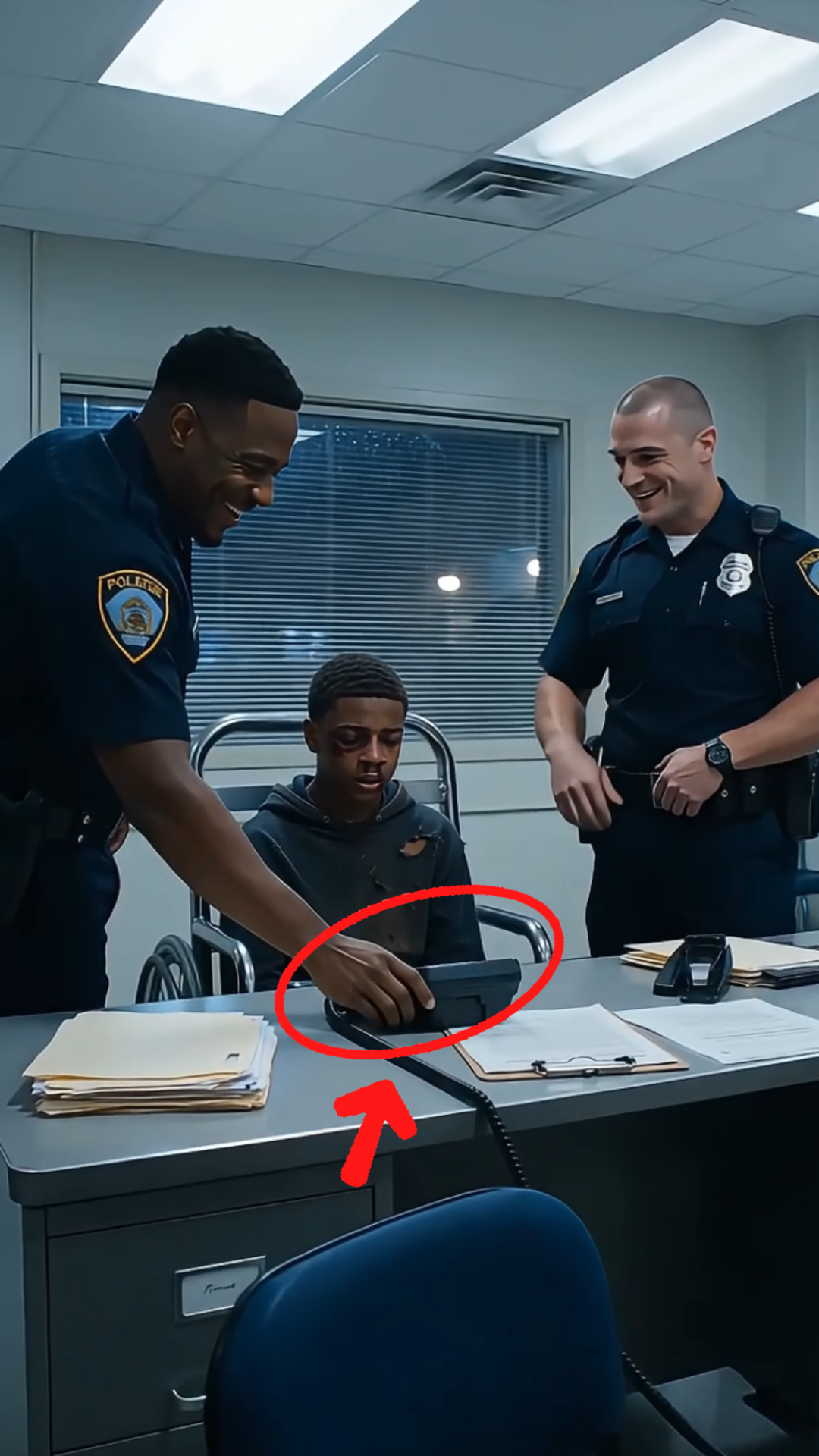
Julian Vance sat alone in the corner of the police interview room, trying to keep his breathing steady. The harsh fluorescent lights above him buzzed softly, filling the silence with an irritating hum. His wrists were sore from the handcuffs, and the expensive white dress shirt he had worn that morning was now wrinkled and stained from the long ordeal.

Just a few hours earlier, the seventeen-year-old had been walking home from a private school debate competition. He still carried the leather folder that held his notes, his tie slightly loosened after a long day of speeches and applause. Julian had been named best speaker, and he could not wait to tell his father.
But that celebration had ended abruptly.
A jewelry store alarm had gone off two blocks away from where Julian was waiting for his driver. Witnesses gave police a vague description of a tall teenage boy in formal clothes. When officers saw Julian standing alone, they decided he fit the description well enough.
He tried to explain.
He showed them his student ID.
He told them where he had been.
None of it mattered.
The officers searched his bag, questioned him in front of strangers, and eventually took him downtown “until things were sorted out.”
At the precinct, the mood among the officers was casual, almost amused.
One detective leaned back in his chair and tossed Julian’s phone onto the metal table.
“Anyone you want to call?” he asked.
Julian looked up calmly.
“Yes,” he said. “I’d like to call my father.”
Several officers exchanged smirks.
One of them chuckled.
“Your father can come pick you up after we’re done.”
Another laughed and muttered, “Every kid thinks Dad is going to save the day.”
Julian said nothing.
He had grown up hearing that assumptions were often made before facts were known. His father had taught him never to argue when emotions were high. Stay calm. Speak clearly. Let the truth do the work.
The detective slid the phone toward him.
“You’ve got one call.”
Julian dialed a number he knew by heart.
The line rang once.
Then twice.
A familiar voice answered.
“Julian?”
For the first time all evening, Julian felt a sense of relief.
“Dad,” he said quietly. “I’m at the downtown precinct. They say I match a suspect description.”
There was a brief pause.
Then his father asked a single question.

“Are you hurt?”
“No.”
“Did you tell them who you are?”
“Yes.”
Another short silence followed.
Then Julian spoke the sentence that changed everything.
“They don’t seem to believe me.”
His father’s voice became firm and controlled.
“Put the detective on the phone.”
Julian held out the device.
The detective took it with a smirk, expecting an angry parent demanding special treatment.
His expression changed within seconds.
“Yes, sir,” the detective said, suddenly sitting upright.
The officers nearby stopped joking.
The detective’s face lost its color.
“Yes, sir. I understand.”
He listened for another few moments, then handed the phone back to Julian with both hands.
“Your father would like to speak with you.”
Julian placed the phone to his ear.
“I’m on my way,” his father said. “Stay where you are.”
The line ended.
The room had gone completely silent.
No one laughed anymore.
The detective cleared his throat.
“Would you like some water, Julian?”
The change was so sudden it felt surreal.
Another officer returned his folder.
A third removed the handcuffs.
“Sorry for the inconvenience,” someone said.
Fifteen minutes later, the front doors of the precinct opened.
Every officer in the lobby turned.
In walked Alexander Vance, one of the most powerful law enforcement officials in the state.
He wore a dark suit and carried himself with calm authority. His reputation was built on integrity, fairness, and an unwavering insistence that the law apply equally to everyone.
He was also Julian’s father.
The police chief hurried forward.
“Mr. Attorney General, we were just—”
Alexander raised his hand.
“Before anyone explains,” he said, “I’d like to see the evidence that justified detaining my son.”
The chief led him to the conference room.
Within minutes, the truth became obvious.4

Security footage from the jewelry store showed a suspect wearing a hooded sweatshirt and running in the opposite direction. The individual looked nothing like Julian.
The only reason Julian had been detained was that he happened to be nearby and fit a broad description.
Alexander listened without interrupting.
When the explanation was finished, he turned to the officers.
“My son was cooperative,” he said. “He provided identification, explained where he had been, and asked to contact his family. Yet he was treated as though his word carried no value.”