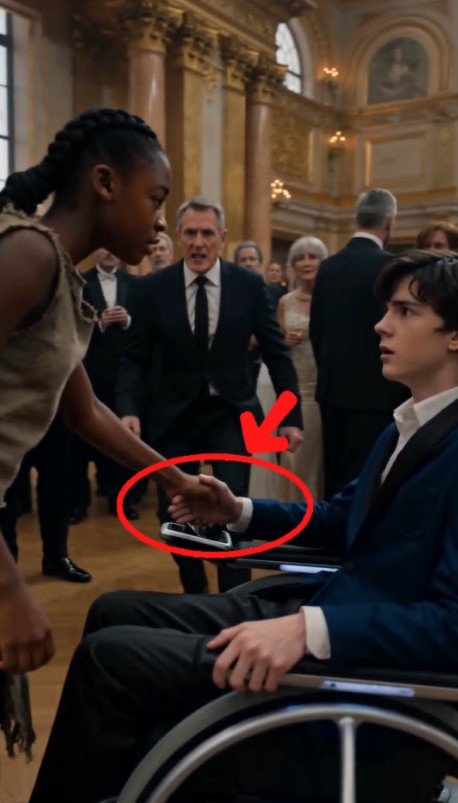
The palace hall shimmered beneath chandeliers that cast warm golden light across polished marble floors. Crystal glasses sparkled on silver trays, and guests in elegant gowns and tailored suits spoke in hushed voices. Everything was carefully arranged, every movement measured, every smile practiced.
At the center of the grand hall sat a young boy in a sleek wheelchair.
He could not have been more than ten years old. He wore a navy-blue suit with gold buttons, and a small crown-shaped pin rested on his jacket. His dark hair was neatly combed, and his posture was perfect. To anyone watching from a distance, he looked like a prince from a storybook.
But his eyes told another story.
Though surrounded by people, he looked completely alone.
Advisors stood nearby discussing his future. Doctors spoke confidently about his condition. Family members made decisions on his behalf. Every person around him seemed certain they knew what was best for him.
And they all believed the same thing.
The boy would never walk again.
The prince had lost the use of his legs after a serious illness several years earlier. Specialists from around the world had examined him. Therapists had worked with him. Treatments had come and gone.
When nothing changed, the adults stopped hoping.
They no longer talked about what he might achieve. Instead, they spoke about what he would need to accept.
The boy listened to every word.

And though he rarely complained, part of him had begun to believe them.
That evening, the palace hosted a celebration attended by nobles, scholars, and distinguished guests. Music floated through the hall, but the prince felt disconnected from all of it.
Then something unexpected happened.
The massive doors at the end of the room creaked open.
A young girl stepped inside.
She was barefoot. Her dress was worn and dusty, and her hair was tousled by the wind. She looked entirely out of place among the glittering decorations and formal attire.
Conversations stopped.
Heads turned.
The guards began moving toward her, but she continued forward with quiet determination.
“No one invited her,” someone whispered.
“She doesn’t belong here,” said another.
But the girl paid no attention.
She walked straight to the prince.
For the first time that evening, the boy’s expression changed. He looked at her with curiosity.
The girl stopped in front of him and smiled.
“Why are you sitting here so sadly?” she asked.
The adults gasped at her boldness.
One advisor stepped forward. “The prince cannot walk.”
The girl looked at the prince, not at the advisor.

“Is that what they told you?” she asked softly.
The boy hesitated, then nodded.
The girl sat on the floor beside him as if they were old friends.
“When I was younger,” she said, “my little brother became too weak to stand. Everyone said he would never run again. But my grandmother told him something important.”
The prince leaned closer.
“She said that sometimes the body needs time,” the girl continued. “And sometimes what people call impossible is only something that hasn’t happened yet.”
The hall had become completely silent.
The prince stared at her.
“No one has ever said that to me,” he whispered.
The girl stood and extended her hand.
“I don’t know whether you will walk today,” she said. “But I think you should keep believing that you can.”
The adults exchanged uncertain glances.
The prince looked at her hand.
For a moment, he did not move.
Then he placed his hand in hers.
With visible effort, he pushed against the armrests of his wheelchair.
His legs trembled.
Several people rushed forward, but the girl raised her free hand.
“Let him try.”
The prince took a deep breath.
Slowly, shakily, he lifted himself.
For one extraordinary moment, he stood.
The hall erupted in astonished murmurs.
Tears filled the queen’s eyes. The doctors stared in disbelief. The advisors were speechless.
The prince’s legs were unsteady, and after a few seconds he sat back down, exhausted but smiling more brightly than anyone had ever seen.
“I stood,” he said.
The girl grinned.
“Yes,” she replied. “And next time, you may stand even longer.”
That single moment changed everything.
The doctors revised his therapy plan. The family began encouraging him instead of limiting him. Most importantly, the prince began believing in himself again.
Weeks turned into months.
He grew stronger.

First he stood. Then he took a step. Then another.
One sunny morning in the palace garden, the prince walked several yards on his own while his family cheered.
But there was one person he wanted to thank.
The palace searched for the barefoot girl, but no one knew where she had gone.