The morning sun had just begun to rise over the vast Australian outback, casting long golden shadows across the open land. The air was dry and still, carrying the faint scent of dust, grass, and eucalyptus.
It was the kind of landscape where distances feel endless, and where human presence is sparse, limited to long dirt roads, scattered farms, and the occasional fence line stretching toward the horizon.
A man driving along one of these rural roads was making his usual early inspection of the property boundaries. It was a routine he had done countless times before—checking fences, ensuring gates were secure, and making sure livestock had not strayed.
Out here, small problems could quickly become large ones if left unnoticed. A broken fence could mean cattle wandering miles away. A blocked path could mean animals trapped without water. It was quiet, simple work, but it required attention.
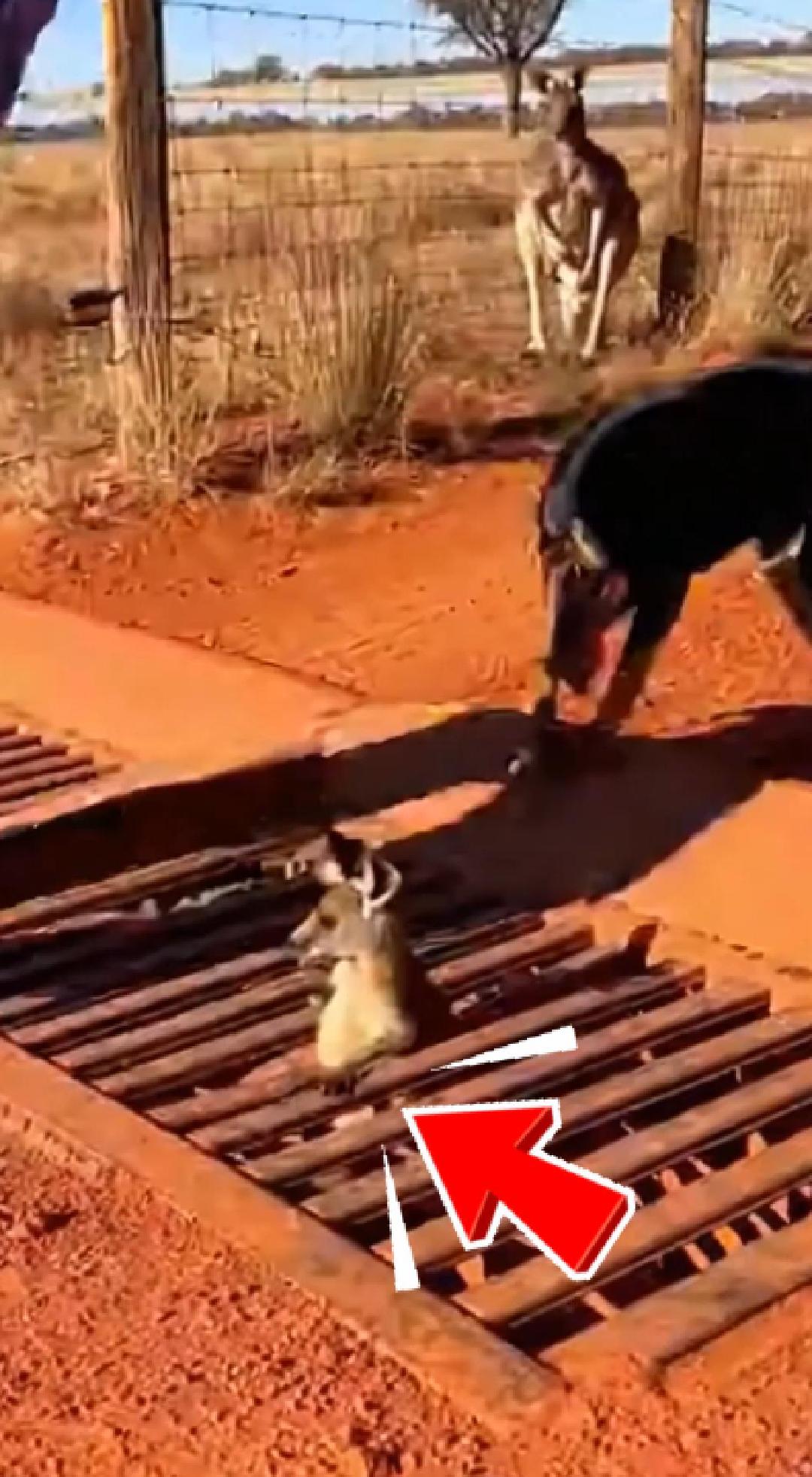
As he drove slowly along the dusty track, something unusual caught his eye. Near one of the cattle guards built into the road, there was movement. At first, it looked like debris caught between the metal bars. But as he slowed down and looked more carefully, he realized it was alive.
A young kangaroo had become trapped in the cattle guard.
The metal structure was designed to prevent livestock from crossing certain boundaries. It consisted of deep gaps between steel bars that animals like cattle would not step into. But smaller or less experienced animals, especially young wildlife, could sometimes misjudge it. The kangaroo had likely tried to cross and fallen through one of the gaps, unable to pull itself back up.
It was stuck between the bars, its body wedged in an awkward position. Its legs kicked weakly against the metal, but there was no leverage, no solid ground to push against. Each attempt only drained more of its energy. The animal was panicked, breathing quickly, its eyes wide with fear and confusion.
The man immediately stopped his vehicle.
He stepped out into the morning air, carefully approaching the cattle guard. As he got closer, he could see the situation more clearly. The young kangaroo was not badly injured, but it was exhausted and trapped in a position that made escape impossible without assistance. The metal bars pressed against its body, restricting its movement and preventing it from turning or climbing out.
He knew that time mattered. The longer the animal remained stuck, the greater the risk of injury or dehydration, especially under the rising Australian sun.
He knelt beside the structure, speaking softly in an attempt to calm the animal. The kangaroo reacted with small movements, still frightened, still trying to escape on its own. But it was too weak to break free.
The man assessed the situation carefully. He understood that pulling too hard or too quickly could injure the animal further. He needed to create space, reduce pressure, and guide it out without causing harm.
Looking around, he returned to his vehicle and retrieved a few simple tools he carried for fieldwork—nothing specialized, just basic equipment that could be adapted in emergencies like this.
Returning to the cattle guard, he began by gently trying to adjust the animal’s position. The kangaroo resisted slightly at first, instinctively reacting to movement, but the man remained calm and slow in his approach. He spoke softly throughout, not expecting the animal to understand his words, but using his voice to reduce panic.
The first step was to relieve pressure on one side of the body. Carefully, he used his hands and a tool to create slight adjustments in angle, ensuring the animal was not being squeezed further by the metal bars. The kangaroo’s breathing gradually slowed as it stopped struggling as intensely.
But freeing it was still not simple.
The structure of the cattle guard meant there was very little space to maneuver. The kangaroo’s hind legs were still caught, and it could not gain enough leverage to lift itself out. The man realized he would need to physically guide it upward while ensuring it had a stable point to push against.
He adjusted his position, working patiently. Each movement was slow and deliberate. There were moments when the kangaroo tried to push itself free, but those attempts only resulted in exhaustion. The man paused each time, allowing it to rest, knowing that forcing the process would only make things worse.
Minutes passed.
The sun rose higher, warming the metal structure and the surrounding ground. The situation remained delicate, but there was progress. The animal was beginning to trust the stillness of the man’s presence, no longer reacting with constant panic.