The oil in the pan was just starting to crackle when I noticed the first car slow down. My food stall sat on the edge of a narrow street, wedged between a closed tailor shop and a faded bus stop sign. It wasn’t much to look at—just a metal cart, a small gas stove, and a hand-painted sign that read Hot Food, Fresh Every Day. I had been working there since dawn, my apron stained, my feet aching, my mind focused on getting through another ordinary day.
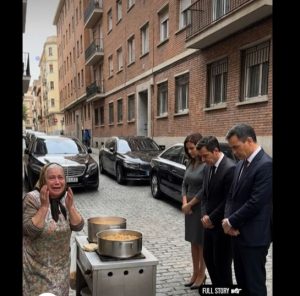
Then the second car appeared.
And then the third.
Three black Rolls-Royces rolled down the street like something out of a movie, their polished surfaces reflecting the dull gray of the surrounding buildings. They moved slowly, deliberately, before stopping directly in front of my stall. The engines purred softly, expensive and controlled.
My heart dropped.
In my world, cars like that didn’t stop for food. They stopped for trouble.
I wiped my hands nervously on my apron, my thoughts racing. Had I violated some permit rule? Was I blocking the sidewalk? Had someone complained? I had seen vendors shut down before—sometimes politely, sometimes not. I had no savings to fall back on. This stall was everything I had.
The doors opened.
Three men stepped out, all wearing tailored suits that probably cost more than my entire cart. One had silver hair and sharp eyes. Another wore dark glasses despite the cloudy sky. The third looked younger, but just as serious. People walking by slowed down, pretending not to stare while clearly staring.
I swallowed hard.
The silver-haired man approached first. He glanced at my sign, then at the food simmering in the pan. His expression was unreadable.
“You own this stall?” he asked.
“Yes,” I replied quickly. “I mean—yes, sir.”
He nodded once. “What do you sell?”
“Rice bowls. Noodles. Soup. Whatever’s hot,” I said, my voice tighter than I wanted it to be.
He looked at the others. “This is the place.”
That was when I truly thought it was over.
I imagined inspectors, fines, confiscation. I imagined my cart being loaded onto a truck while I stood helplessly on the sidewalk. My parents’ voices echoed in my head, reminding me how hard it had been to save enough to start this stall after my factory job shut down.
The younger man stepped forward. “We’ll take three of whatever you recommend.”
I blinked. “Excuse me?”
“Food,” he said calmly. “We’re hungry.”
I hesitated, then moved on instinct. My hands knew what to do even if my mind was spinning. I scooped rice, stirred sauce, added vegetables and meat, plating each bowl carefully despite my shaking fingers.
As I handed over the food, the silver-haired man watched closely—not just the food, but me. The way I worked. The way I treated each bowl like it mattered.
They took the food to a small folding table one of their drivers set up beside the cars. People had fully stopped now, openly watching. Three Rolls-Royces, street food, and silence—it was an unusual combination.
They ate without speaking at first.
Seconds passed. Then a minute.
Finally, the silver-haired man nodded slowly. “This,” he said, “is very good.”
Relief washed over me, but it didn’t last long.
“Who taught you to cook like this?” he asked.
“My mother,” I answered. “She used to run a small kitchen before she got sick.”
He paused. “And you’ve been here how long?”
“Almost two years.”
He exchanged a glance with the man in dark glasses. “Do you know who we are?”
My stomach tightened again. “No, sir.”
“That’s good,” he said. “Means you treat everyone the same.”
He stood and walked back to my stall. “I’m Victor Lang.”
The name hit me like a physical blow.
Everyone in the city knew Victor Lang. Billionaire. Real estate magnate. Owner of hotels, shopping centers, entire blocks of the city. The kind of man whose decisions reshaped neighborhoods overnight.
He pulled out a business card and placed it on my counter. “I’m buying the old warehouse two streets from here. I want to turn part of it into a proper food court. Clean. Affordable. Run by people who know food.”
Victor looked around—the cracked pavement, the peeling walls, the people who had quietly gathered to listen.
“Because success shouldn’t erase places like this,” he said. “It should protect them.”
The other men stood. One paid, leaving an amount that made my eyes widen. Another nodded at me respectfully.
Victor paused before getting into his car. “Don’t change your food,” he said. “Just change how many people you serve.”